What Is Experiential Learning, and Why Does It Matter for Your Child?
 By Shemrocks Patiala
Choosing a school is no longer about a place where children simply finish their school curriculum and prepare for exams. Today’s parents seek learning spaces where children can grasp concepts, pose questions, and build skills that will strengthen them beyond the classroom.
That’s why experiential learning has become so important in modern education. It helps children learn from experience, reflection, and application rather than just memorisation. Parents looking for schools in Patiala can understand the school’s learning approach to make a more informed choice.
Meaning of Experiential Learning
It is a teaching approach in which children acquire knowledge through direct experience and active participation.
It is not just about performing activities in the classroom. It is a systematic process in which children experience, reflect, connect their experiences to concepts, and apply their understanding in new situations.
In simple terms, it means learning by doing.
For example, rather than just reading about plant growth in a textbook, children can observe plants, track the changes as they grow, record their findings, understand the scientific concepts behind the process, and reflect on what they have learned.
This way, children understand not only what they are learning but also why it matters.
What Is David Kolb’s Experiential Learning Theory?
One of the most well-known theories of experiential learning is that of the American educational theorist, David Kolb.
In 1984, Kolb published his book Experiential Learning: Experience as the Source of Learning and Development, in which he introduced his theory. It describes learning as a process of continuous conversion of experience into knowledge.
According to Kolb, effective learning involves four interconnected stages:
- Concrete Experience
- Reflective Observation
- Abstract Conceptualisation
- Active Experimentation
These stages together help children move from simply experiencing something to understanding it, applying it, and improving through practice.
How Does Kolb’s Four-Stage Learning Cycle Work?
1. Concrete Experience: Learning Through Direct Experience
The first stage begins when children are actively involved in an experience.
Children work with materials, situations, or real-life examples, instead of just listening to explanations.
This might include:
- Conducting scientific experiments
- Model building
- Nature exploration
- Role-play participation
- Project making
For example, while learning about structures, children may build a bridge model using different materials.
At this stage, they begin by asking, “What am I experiencing?” The experience creates the foundation for deeper learning for them.
2. Reflective Observation: Understanding What Happened
Experience alone is not enough. Children need time to think about what they saw.
They ask themselves questions such as, ‘What worked?’ What were the challenges I faced? Why did that happen? What should I do better?
For example, after building a bridge model, children might talk about why one design was stronger than another.
This reflection helps them to see the connection between actions and consequences.
3. Abstract Conceptualisation: Connecting Experiences With Concepts
At this stage, children relate their observations to academic knowledge. The teacher helps them to grasp the ideas and principles that are behind their experience.
For example, after experimenting with bridge structures, children learn about balance, distribution of weight, design principles, etc.
This stage ensures that activities are not separate from academics but become a meaningful way to understand concepts.
4. Active Experimentation: Applying Learning in New Situations
The final stage encourages children to use their understanding in different situations.
They ask:
- How can I improve my approach?
- Where else can I apply this knowledge?
- What happens if I try another method?
For example, children may redesign their bridge using their previous observations and test whether the new structure works better.
This creates a continuous cycle of learning, improvement, and discovery.
Best School in Patiala Moving Towards Experiential Learning
Education today is moving away from the memorisation of information and is increasingly focused on the development of understanding and skills.
The National Education Policy (NEP) 2020 calls for schools to adopt competency-based learning techniques focusing on critical thinking, creativity, problem-solving, and practical application.
Modern CBSE schools are increasingly incorporating:
- Activity-based learning
- Project work
- Experiments
- Real-world applications
- Collaborative learning
- Skill development activities
A progressive experiential learning CBSE school in Patiala should not only focus on completing chapters but also help children understand how knowledge connects with everyday life.
What Does Experiential Learning Look Like in a Classroom?
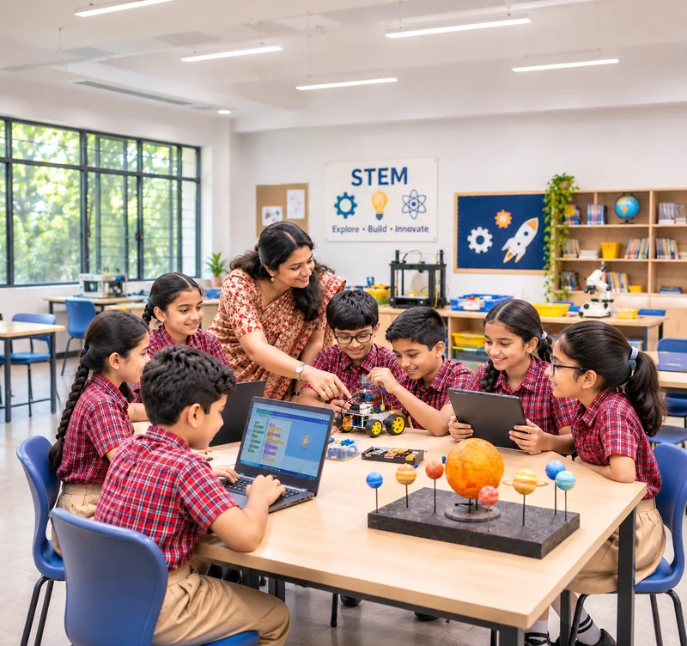
It can be applied across different subjects.
Science: Exploring Concepts Through Experiments
Instead of just memorising scientific facts, children can experiment, observe, and draw conclusions.
For example, children can explore ecosystems more meaningfully by observing plants, analysing their surroundings and understanding environmental relationships.
Mathematics: Connecting Numbers With Real Life
Children learn mathematics better when they see how it is used in the real world.
They learn concepts by engaging in activities like measurements, shapes, patterns, and problem-solving instead of rote memorisation of formulas.
Social Sciences: Learning Through Discussion and Experiences
Children can explore historical and social concepts through role-plays, presentations, discussions, research projects, and so forth. They develop communication skills and understand different perspectives.
What Are the Benefits of Experiential Learning for Children?
1. Better Understanding and Retention
When children get to experience concepts practically, they develop a stronger understanding of how things work.
The benefits of learning by doing are more engagement, greater understanding, and the ability to connect classroom learning to real-life situations.
2. Stronger Critical Thinking and Problem-Solving Skills
Learning by doing encourages children to analyse situations, explore different solutions, and apply acquired learning to real-world problems. Instead of simply finding the right answer, they develop the ability to think independently, make decisions and overcome challenges.
3. Greater Confidence and Independence
Children develop confidence in their abilities as they play, invent and solve problems. They see mistakes not as failures but as opportunities to improve.
4. Development of Future-Ready Skills
Experiential learning fosters skills children need for the future, such as:
- Communication
- Creativity
- Cooperation
- Adaptability
- Decision-making
These skills help children to become confident learners.
5. Increased Curiosity and Engagement
Children are naturally curious about the world around them. A learning environment that encourages questioning and discovery can help children develop a lifelong interest in learning.
Shemrock School Patiala
A New Learning Experience Awaits
Admissions
A New Learning Experience Awaits
Shemrock School Patiala: Best School in Patiala
Meaningful education happens when children do not just receive information but actively experience, question, and discover. At Shemrock School Patiala, learning is based on the belief that the child should be prepared for life and not just for examinations.
We are an upcoming experiential learning CBSE school in Patiala that aims to create a learning environment where children can understand ideas, apply knowledge, and develop skills for the future.
We strive to provide opportunities for children to explore concepts, develop curiosity, and gain confidence through child-centric teaching methodology, activity-based experiences, and the Shemrock Learning System.
Stay tuned for more updates.