Coding and STEM Education in Schools: When to Start?
 By Shemrocks Patiala
Technology is becoming an increasingly important part of our everyday lives, and children are growing up in a world shaped by scientific discoveries, digital devices and artificial intelligence (AI). This raises an important question for parents: At what age should children start exploring STEM and learning to code?
The answer is not to introduce complex programming languages at an early age. Instead, children should be encouraged to develop curiosity, logical thinking, creativity and problem-solving skills through age-appropriate STEM experiences. Activities such as building with blocks, exploring patterns, solving puzzles, experimenting with everyday materials and using simple coding games can help lay the foundation for future learning. As children grow, these experiences can gradually progress towards coding, robotics and more advanced technological concepts.
Today, STEM education in schools focuses on developing these foundations through exploration, creativity and practical experiences.
For parents exploring CBSE schools in Patiala, understanding how a school introduces coding and STEM learning can help them choose an environment that prepares children for the future.
What Is STEM Education and Why Does It Matter?
STEM stands for Science, Technology, Engineering and Mathematics. STEM education brings together these four areas to teach children how concepts connect and can be applied in the real world.
Unlike traditional learning approaches that may focus mainly on remembering information, STEM learning encourages children to:
- Ask questions
- Explore different possibilities
- Develop solutions
- Test their ideas
- Learn from mistakes
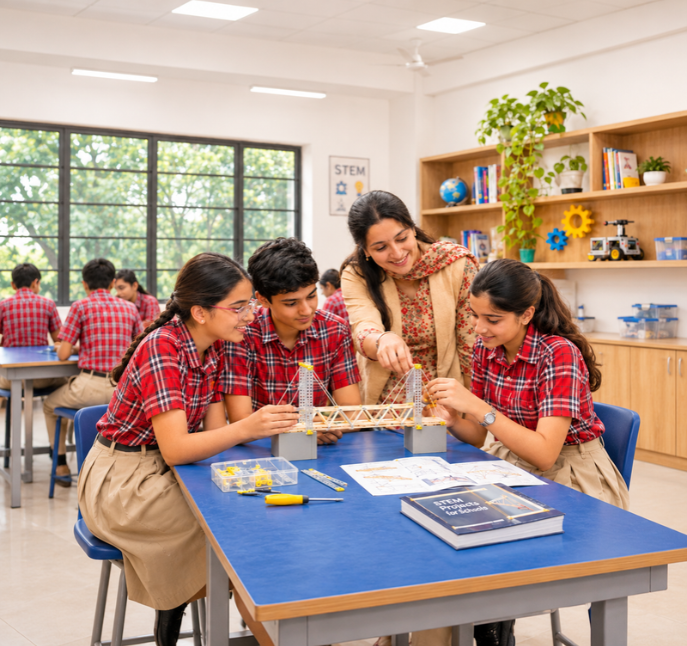
For example, a child learning about engineering may not only study structures but also design and build a model. Similarly, a child learning to code may create a simple animation while developing an understanding of logic, patterns and sequencing.
This makes learning more practical and meaningful.
Is Coding the Same as STEM Education?
Coding is an important part of STEM education, but the two are not the same thing.
Coding teaches children how to give instructions to computers and helps them develop logical thinking skills. STEM education is broader and includes scientific exploration, mathematical reasoning, engineering concepts and technological understanding.
A child engaged in STEM learning may:
- Construct a robot model
- Develop a solution to a problem
- Explore scientific concepts
- Design digital projects
- Analyse data
Coding is one way children can bring their ideas to life. Some CBSE schools in Patiala also incorporate STEM activities into their broader approach to skill development.
What Age Should Children Start Learning Coding?
There is no single age at which every child should learn to code. The right time to begin depends on the child’s age, interests and readiness.
At a younger age, the goal is not to teach advanced programming. Instead, children should develop the thinking skills that form the foundation of coding.
Ages 3 to 5: Building Logic Through Play
In the early years, children learn best through play, exploration, and interaction.
At a Playway school in Patiala, early STEM concepts can be introduced through activities such as:
- Pattern recognition games
- Building blocks
- Sorting and classification activities
- Puzzles
- Simple sequencing games
These activities help children develop:
- Logical thinking
- Observation skills
- Creativity
- Problem-solving skills
At this stage, children are developing the thinking skills behind coding rather than writing code.
Ages 6 to 8: Developing Computational Thinking
Children can begin learning basic coding concepts during their primary school years.
Activities may include:
- Block-based programming platforms
- Simple animations
- Digital storytelling
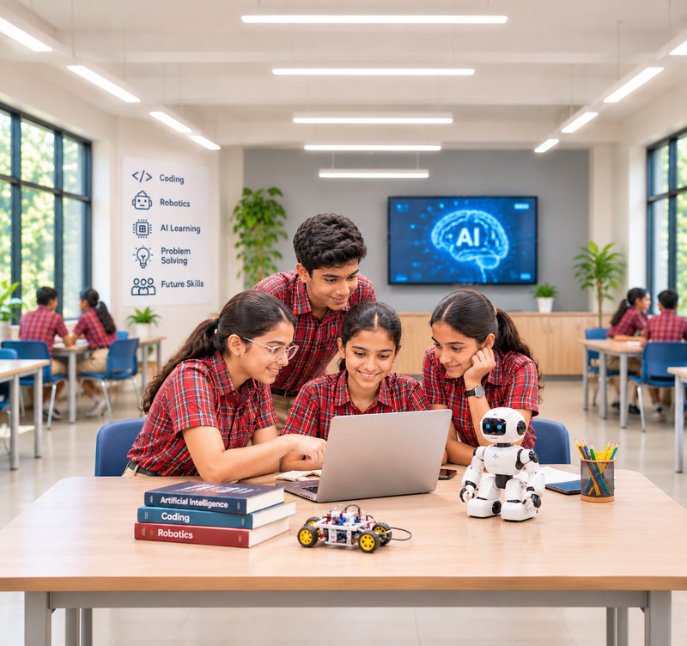
- Introductory robotics activities
Children begin to understand concepts such as:
- Sequencing
- Patterns
- Commands
- Cause and effect
This stage helps children understand that problems can be broken into smaller steps and solved systematically.
Ages 9 to 12: Applying Coding Skills Through Projects
Children can explore more structured coding experiences during their upper primary and early middle school years.
They may work on:
- Game development
- Building basic applications
- Programming robots
- Developing digital projects
At this stage, coding becomes a way for children to express their ideas and solve problems.
Children begin to develop stronger skills in:
- Logical reasoning
- Creativity
- Collaboration
- Design thinking
Ages 13 and Above: Exploring Advanced Applications
More advanced topics for older students are:
- Programming languages
- Artificial intelligence concepts
- Basic data science
- Robotics
- App development
The foundations developed during earlier years can help students approach these areas with greater confidence.
Why Should Children Learn Coding and STEM at an Early Age?
1. It Develops Problem-Solving Skills
Coding teaches children that challenges can be approached step by step. When a programme doesn’t work, children learn to identify the problem, make changes, and try again.
This mindset is useful far beyond technology.
2. It Encourages Creativity
Many people think coding is only about technology, but it is also a creative process.
Children use coding to create:
- Stories
- Games
- Designs
- Solutions
They learn that technology can be a tool for bringing ideas to life.
3. It Builds Confidence Through Experimentation
STEM activities allow children to explore without feeling pressured to find the right answer immediately.
Through experimentation, they learn to test ideas, make improvements and discover what works.
This reflects the principles of experiential learning, through which children develop their understanding through active participation and practical experiences.
4. It Develops Future-Ready Skills
The future will demand more than academic knowledge from today’s children.
STEM learning supports skills such as:
- Critical thinking
- Communication
- Collaboration
- Creativity
- Adaptability
These skills help children become confident learners.
How Does STEM Learning Happen Through Experiential Learning?
Experiential learning helps children understand STEM concepts by applying them in practical situations. Through hands-on activities, they discover how classroom learning connects with everyday life.
For example:
- Science and Technology: Children can explore energy by building simple models and observing how different energy sources produce movement or light.
- Mathematics and Engineering: Children can apply concepts such as measurement, shapes and proportions while designing and building structures.
- Creativity and Coding: Children can use coding to create projects that solve simple real-world problems, rather than simply memorising commands.
This approach encourages children to learn by doing, experiment with ideas, solve problems and apply their knowledge to real-life situations.
What Should Parents Look For in a School Offering STEM Education?
When comparing top schools in Patiala, parents should look beyond whether a school simply offers coding classes.
A strong STEM programme should include the following elements:
Developmentally appropriate learning
Activities should be aligned with child’s developmental stage without placing unnecessary pressure on them.
Practical Experiences
Children need opportunities to build, experiment, and create.
Experienced Educators
Teachers should guide children through exploration rather than simply giving instructions.
Integration With Regular Learning
STEM should connect with subjects such as science, mathematics and everyday problem-solving.
Focus on Skills, Not Just Technology
The purpose of STEM is not just to teach children how to use technological tools. It is also to develop their ability to think, create and solve problems.
STEM Education at Shemrock School Patiala
Shemrock School Patiala is being developed to provide a learning environment that encourages curiosity, creativity and confidence in children.
Our focus is on an educational approach that encourages exploration, practical understanding and skill development.
Through experiential learning and hands-on activities, we aim to help children understand concepts, apply their knowledge and develop essential skills through projects and meaningful experiences.
For parents looking for the best school in Patiala for their children, it is important to consider how effectively a school prepares learners for future challenges.
Choosing a School That Prepares Children for Tomorrow
The purpose of coding and STEM education is not to make every child a programmer. Instead, it is to develop logical thinking, problem-solving abilities, creativity and the confidence to approach challenges.
The right learning environment introduces these skills gradually through age-appropriate, hands-on experiences that encourage children to ask questions, explore ideas and develop their abilities at their own pace.
Parents exploring CBSE schools in Patiala should consider how a school integrates STEM education with academic learning and real-world experiences to help children build strong foundations for the future.
Ultimately, the goal is not just to help children understand how technology works, but to empower them to apply their knowledge, think creatively and develop meaningful solutions to real-world problems.
Shemrock School Patiala
A New Learning Experience Awaits
Admissions
A New Learning Experience Awaits